
Finishing a book is not the same as retaining it.
Most readers forget the majority of what they read within weeks of finishing a book. This is not a failure of willpower or intelligence. It is a predictable outcome of how human memory functions when information is consumed without a structured retention mechanism.
The forgetting curve, documented by psychologist Hermann Ebbinghaus in the 1880s, demonstrates that newly acquired information decays exponentially without reinforcement. Passive reading—moving through text linearly without strategic intervention—produces minimal long-term retention. The knowledge extracted from dozens of books can evaporate within months.
A reading system is a structured, repeatable framework that includes selection criteria, reading methods, note-taking protocols, retention mechanisms, application processes, and review cycles designed to extract and compound knowledge from books over time.
Most readers lack this framework entirely. Bookorya approaches reading as cognitive infrastructure design rather than content consumption.
What Is a Reading System?
A reading system is not a goal (“read 50 books this year”), a habit (“read 30 minutes daily”), or a technique (“speed reading”). It is an integrated framework that governs how you interact with written material from selection to long-term retention.
Reading System vs Reading Goals vs Reading Habits
The distinction matters because most readers conflate these concepts:
A reading goal specifies an outcome target: finish 30 books this year, read one book per week. Goals answer “what” but not “how.”
A reading habit establishes behavioral consistency: read every morning, dedicate 30 minutes before bed. Habits ensure regular practice but do not determine knowledge extraction quality.
A reading system provides process infrastructure: repeatable protocols for selecting books, extracting knowledge, encoding information into memory, and applying insights over time. Systems specify how you interact with material regardless of specific titles or quantities.
A complete reading system includes six structural components:
- Selection criteria: A method for choosing books aligned with intellectual objectives rather than impulse or social pressure.
- Reading method: A deliberate approach to processing text—whether deep analytical reading, strategic skimming, or targeted extraction depending on material type and purpose.
- Note-taking framework: A consistent structure for capturing key arguments, evidence, counterarguments, and connections while reading.
- Retention mechanism: Active processes (not passive re-reading) that encode information into long-term memory through retrieval practice and spaced repetition.
- Application process: A method for connecting new knowledge to existing frameworks, testing concepts, and using information in practice.
- Review cycle: Scheduled intervals for revisiting material to combat the forgetting curve and deepen understanding over time.
Without all six components functioning together, knowledge acquisition remains fragmented and unsustainable. You may finish books, but you do not systematically extract and compound their value.
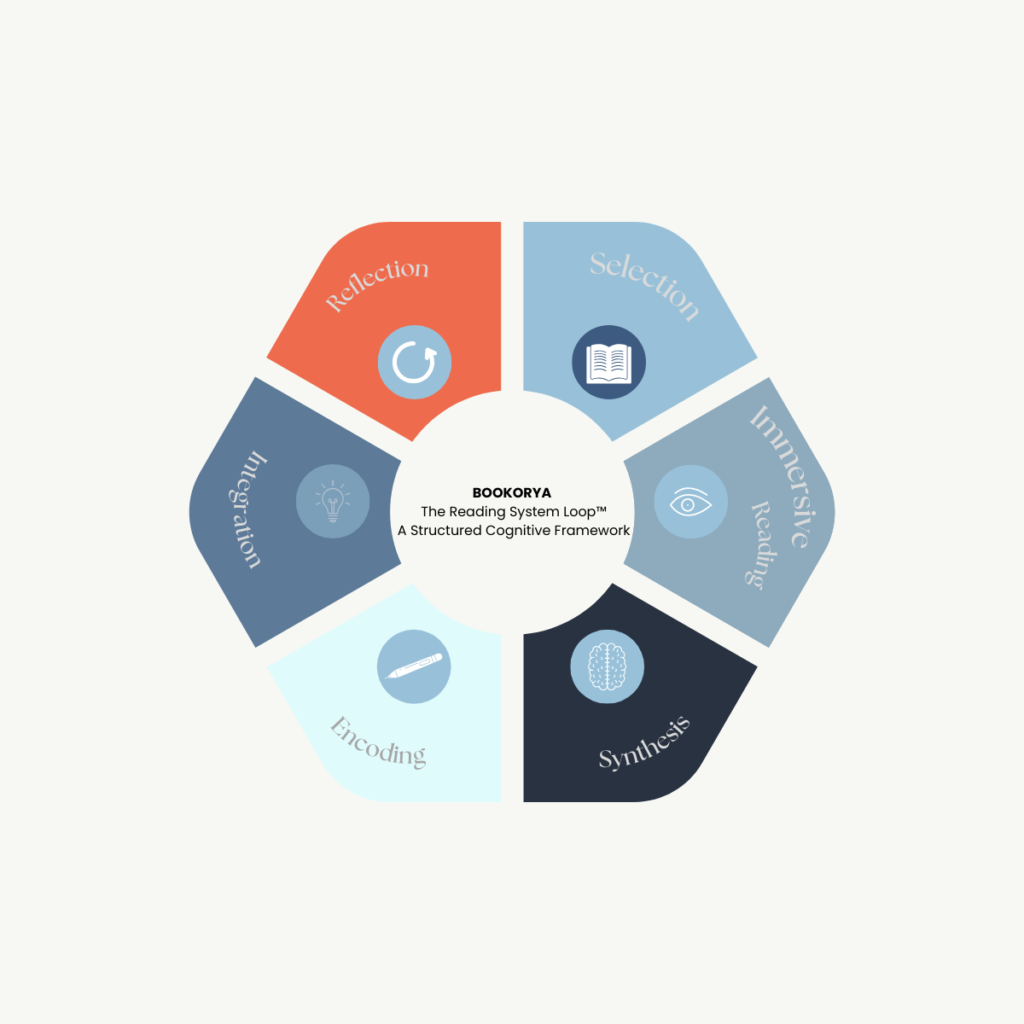
Figure: The Bookorya Reading System Loop — a structured cognitive framework for retention and knowledge integration.
The Bookorya Reading System Loop
A complete reading system operates as a closed loop where each component reinforces the others.
Selection defines intellectual direction. Books are chosen based on knowledge gaps, conceptual questions, or skill development objectives rather than external recommendations or arbitrary targets.
Immersive Reading ensures depth without sacrificing analytical rigor. Sustained attention combined with active questioning produces comprehension that surface reading cannot achieve.
Synthesis extracts core models. Post-reading analysis identifies central arguments, evaluates evidence quality, and distills transferable frameworks rather than collecting disconnected facts.
Encoding strengthens memory traces. Active recall and spaced repetition transform information from temporary activation into retrievable long-term knowledge.
Integration connects across domains. Thematic organization of retained material reveals patterns and relationships invisible when books remain isolated.
Reflection reinforces learning cycles. Periodic review identifies gaps, challenges assumptions, and generates questions that inform the next selection phase.
The loop continues indefinitely. Each cycle compounds previous knowledge while refining analytical capabilities.
Why Most Readers Don’t Have a Reading System
Most readers operate without a system for three structural reasons that compound over time.
They optimize for consumption metrics
Book counts dominate reading culture. Annual reading challenges, social media sharing of finished books, and productivity content emphasize quantity as the primary metric. This creates incentive structures that reward speed and volume over depth and retention.
Consumption-focused reading produces the illusion of learning. You complete books and accumulate titles on your reading list, but the knowledge does not integrate into your working understanding. The act of finishing becomes the goal rather than the transformation of how you think.
They rely on passive engagement
The default reading mode is passive consumption: moving linearly through text, occasionally highlighting sentences that seem important, perhaps taking scattered notes. This approach feels productive because you are “doing something,” but it does not engage the cognitive processes necessary for long-term retention.
Cognitive science distinguishes between recognition (familiar when you see it) and recall (retrievable when you need it). Passive reading builds weak recognition without the retrieval strength required for practical application. You may recognize concepts when re-reading, but you cannot access them independently when relevant problems arise.
They lack structured retention protocols
Most readers do not distinguish between reading and learning. They assume that attention during reading translates automatically to retention afterward. This assumption is contradicted by memory research.
Retention requires deliberate encoding through active recall, spaced repetition, and elaborative interrogation. Without these mechanisms built into a reading workflow, information decays according to the forgetting curve regardless of how carefully you initially read.
The absence of structured retention is not laziness. It reflects the fact that most readers have never been taught systematic knowledge management as a distinct skill separate from reading comprehension.
The 3 Pillars of a Reading System
A functional reading system rests on three foundational pillars that work interdependently to produce compounding intellectual returns.
Pillar 1: Reading Efficiency Without Sacrificing Depth
Reading efficiency is not speed. It is the optimization of cognitive resources toward material that justifies deep engagement while filtering content that does not.
Deep reading involves sustained attention, active questioning, and critical evaluation of arguments. Cognitive research distinguishes this from surface reading—rapid scanning that extracts basic meaning without analytical processing. Different material requires different approaches.
A serious reading system includes decision rules for when to deploy deep reading versus strategic extraction. Academic research, foundational texts, and complex arguments demand full cognitive engagement. Secondary sources, confirmatory evidence, and peripheral material may require only targeted extraction of specific claims or data.
This pillar prevents the common failure mode of treating all text identically, which either wastes time on material that does not warrant depth or rushes through complex arguments that require sustained analysis.
Pillar 2: Knowledge Retention and Application
Retention transforms information from temporary activation in working memory to retrievable knowledge in long-term memory. This transformation does not occur through repetition of exposure but through active retrieval and meaningful connection.
Active recall—forcing yourself to retrieve information from memory without prompts—strengthens memory traces more effectively than re-reading. Spaced repetition—reviewing material at increasing intervals—combats the forgetting curve by reinforcing retrieval pathways before they decay.
Synthesis integrates new information with existing knowledge structures. This involves identifying connections across sources, recognizing patterns, challenging previous assumptions, and building conceptual frameworks that organize information hierarchically.
Application grounds abstract knowledge in concrete practice. Testing concepts in real situations, explaining ideas to others, and using frameworks to analyze new problems all strengthen retention while revealing gaps in understanding.
Pillar 3: Analytical Reading Skills
Analytical reading evaluates the quality of arguments, evidence, and reasoning rather than simply absorbing claims as presented. This pillar separates serious readers from passive consumers.
When reading a behavioral economics book, a reading system forces you to ask: What is the core model being proposed? What empirical evidence supports it? Under what conditions might this model fail? What alternative explanations exist? These questions transform passive consumption into active interrogation.
Argument evaluation involves identifying premises, examining logical structure, detecting unstated assumptions, and assessing whether conclusions follow from evidence. Many readers accept claims that align with existing beliefs without subjecting them to scrutiny.
Research evaluation examines the methodology, sample sizes, potential biases, and limitations of studies cited as evidence. A single study does not establish a claim. Correlation is not causation. Statistical significance does not imply practical importance. Readers without analytical frameworks often miss these distinctions.
Structural analysis examines how texts are organized to persuade. Recognizing rhetorical techniques, identifying when emotion is substituted for evidence, and detecting when complexity is obscured through simplification all contribute to accurate comprehension.
What a Simple Reading System Looks Like (Example)
A functional reading system does not require complexity. The following workflow demonstrates the core components operating together:
Step 1: Intentional book selection Choose books based on specific knowledge gaps, intellectual questions, or skill development rather than bestseller lists or social media recommendations. Maintain a curated reading queue organized by priority and purpose.
Step 2: Pre-reading structure scan Before deep reading, examine the table of contents, introduction, and conclusion to understand the author’s thesis and organizational structure. Identify which sections require deep engagement versus strategic skimming.
Step 3: Active reading with margin prompts Read with specific analytical questions: What is the central argument? What evidence supports it? What are potential counterarguments? How does this connect to other knowledge? Make marginal notes that respond to these prompts rather than passively highlighting.
Step 4: Post-reading synthesis Within 24 hours of finishing, write a structured summary that includes: main thesis, key supporting arguments, evaluation of evidence quality, connections to other material, and specific applications. This forces active recall and identifies gaps in understanding.
Step 5: 30-day review Schedule a review session approximately one month after reading. Attempt to recall main arguments without consulting notes, then verify accuracy and fill gaps. This spaced repetition significantly improves long-term retention.
Step 6: Knowledge integration File synthesis notes in a personal knowledge database organized by topic or theme rather than chronologically by book. This allows concepts from multiple sources to combine and generate novel insights through cross-referencing.
This workflow contains all six components of a reading system operating in sequence. Each step serves a specific cognitive function that contributes to long-term retention and application.
The Compounding Effect of a Reading System
Knowledge compounds through the interaction of retained information across time. Each new book you read with a system becomes exponentially more valuable because you can connect its ideas to frameworks already encoded in long-term memory.
This compounding occurs through several mechanisms.
Context acceleration: Retention from previous reading provides context that accelerates comprehension of new material. Concepts that would seem unfamiliar in isolation become recognizable as variations or extensions of existing knowledge.
Cross-domain synthesis: Connections emerge when information from multiple sources is organized thematically rather than chronologically. A political science text, a psychology study, and a history book may all illuminate the same phenomenon from different angles. Without a system that links these sources, the connections remain invisible.
Skill transfer: Analytical abilities strengthen through repeated practice. Evaluating arguments, assessing evidence, and detecting reasoning flaws become automatic rather than effortful. This skill transfer makes every subsequent book more intellectually productive than the previous one.
The compounding effect means that sustained reading with a system produces disproportionate returns over time compared to high-volume reading without retention infrastructure.
Common Myths About Reading Systems
Several misconceptions prevent readers from developing structured approaches to knowledge acquisition.
Myth: Speed is the goal Speed reading techniques promise to double or triple reading rates through visual training and subvocalization reduction. These methods sacrifice comprehension for velocity. Research consistently shows that faster reading produces significantly worse retention and understanding of complex material. Reading systems prioritize extraction efficiency and retention quality, not raw speed.
Myth: More books equal more knowledge Book counts measure consumption, not learning. A reader who retains a small fraction from many books accumulates less usable knowledge than a reader who retains substantially more from fewer books through systematic practice. The cultural obsession with quantity ignores the reality that unretained information provides no intellectual value regardless of how many books you finish.
Myth: Highlighting equals learning Highlighting feels productive because it involves physical action and creates visible marks. But passively marking sentences that seem important does not engage retrieval processes necessary for memory encoding. Most highlighted passages are never reviewed, and even when reviewed, recognition does not equal recall. Highlighting without active processing is largely performative.
Myth: Memory is automatic The assumption that attention during reading automatically translates to long-term retention contradicts established memory research. Information requires active encoding through retrieval practice, elaboration, and spaced repetition. Without deliberate retention mechanisms, even carefully read material decays within weeks according to the forgetting curve.
How to Build Your Own Reading System
Building a functional reading system requires developing specific skills and protocols that work together as an integrated framework.
When deep engagement is required, structured analytical protocols become essential. [Internal Link: The Bookorya Method for Deep Reading]
Active recall techniques transform passive review into retrieval practice that strengthens memory. Understanding how to implement these techniques specifically for nonfiction material requires adapting spaced repetition principles to complex arguments rather than discrete facts. [Internal Link: Active Recall for Nonfiction Books]
The distinction between deep reading and speed reading clarifies when each approach is appropriate and how they serve different cognitive functions in a complete reading system. [Internal Link: Deep Reading vs Speed Reading]
A personal knowledge database organizes retained information thematically, enabling cross-referencing and synthesis across sources. Building this system requires decisions about structure, tagging, and retrieval methods. [Internal Link: Building a Personal Knowledge Database]
Each component contributes to a complete framework that makes reading exponentially more productive over time through compounding knowledge effects.
FAQ
What is a reading system?
A reading system is a structured, repeatable framework that includes six components: selection criteria for choosing books, a reading method appropriate to material type, a note-taking framework for capturing key information, retention mechanisms that encode knowledge into long-term memory, an application process that connects concepts to practice, and a review cycle that combats the forgetting curve. It differs from reading goals or habits by providing an integrated process for knowledge extraction and retention rather than simply specifying how much or how often to read.
How do you retain what you read?
Retention requires active encoding processes rather than passive re-reading. Active recall—retrieving information from memory without prompts—strengthens memory traces more effectively than repetition. Spaced repetition—reviewing material at increasing intervals (24 hours, 1 week, 1 month, 3 months)—combats the forgetting curve by reinforcing neural pathways before they decay. Synthesis—connecting new information to existing knowledge frameworks—creates multiple retrieval pathways that make information more accessible. Application—using concepts in practice—grounds abstract knowledge in concrete experience that enhances retention.
Are reading systems better than speed reading?
Reading systems and speed reading serve fundamentally different purposes. Speed reading sacrifices comprehension and retention for increased reading velocity. Research shows that comprehension declines significantly as reading speed increases beyond natural rates. Reading systems optimize for knowledge extraction and long-term retention rather than consumption speed. For complex nonfiction that justifies deep engagement, reading systems produce exponentially better outcomes. Speed reading may be appropriate for material that requires only surface-level information extraction, but it cannot substitute for systematic knowledge acquisition.
How long does it take to build a reading workflow?
Implementing a basic reading system requires approximately 4-6 weeks to establish new protocols and adjust to active reading processes. Initial implementation increases time investment per book because active annotation, synthesis, and review require more effort than passive consumption. However, improved retention means that fewer books read with a system produce more usable knowledge than many books read passively. The time investment compounds positively as analytical skills strengthen and cross-referencing becomes automatic.
Do I need special tools or software for a reading system?
A functional reading system requires minimal tools. Physical books work effectively with pencil marginalia and index cards for synthesis notes. Digital tools like Obsidian, Notion, or Roam Research enable more sophisticated cross-referencing and search functionality for knowledge databases, but they are not necessary for core retention processes. The essential requirement is consistent application of active recall, spaced repetition, and synthesis protocols rather than specific software. Many readers benefit from starting with analog methods before introducing digital complexity.
A reading system transforms books from temporary stimulation into long-term cognitive assets. The framework itself—not book counts or reading speed—determines whether knowledge compounds or evaporates.