
You’ve been meaning to “get your life together” for a while now.
Maybe you set big goals at the start of the year. Maybe you’ve downloaded apps, watched YouTube videos, made aesthetic notion dashboards—and yet, here you are, still feeling like you’re spinning your wheels.
You’re not lazy. You’re not broken. You’re just missing the right starting point.
The truth is, most people drown in options. There are thousands of self-improvement books out there—all promising to be the best books for productivity and success—and instead of clarity, you get paralysis. You don’t know what to read first, so you read nothing at all.
But here’s what most people get wrong: you don’t need to read more. You need to read the right one.
One book, read at the right time, can completely reframe how you see yourself and the world. I’ve seen it happen. I’ve felt it happen. And in this guide, I’m going to help you find your book—the one that actually matches where you are right now.
Let’s get into it.
If You Read Only One Book, Start Here
→ Atomic Habits by James Clear
If you’re new to self-improvement or you’ve tried and failed to build habits before, stop everything and start here.
Atomic Habits is the most universally applicable, immediately actionable book in this genre. It doesn’t ask you to overhaul your life overnight. It doesn’t demand willpower or motivation. Instead, it teaches you something quietly revolutionary: that the person who improves 1% every day becomes dramatically different from the person who doesn’t.
The core idea is simple—small habits, compounded over time, produce extraordinary results. But what makes this book different is how Clear teaches you to build those habits. He gives you a clear four-step system (cue, craving, response, reward) that explains why you keep failing—and, more importantly, exactly how to fix it.
This is, without question, the best starting point for anyone looking for the best self-improvement books for beginners.
Here’s why:
- It works whether you want to exercise more, procrastinate less, save money, or read more books.
- It explains human psychology without being overwhelming.
- You can apply what you learn on day one.
If you’ve been stuck for a while, this is where you should start.
Best Book Based on Your Situation
Not everyone is in the same place. Here’s how to find your match.
If You Lack Discipline → Atomic Habits by James Clear
What problem does this book solve?
Most people think discipline is about willpower—that some people just have more of it. Atomic Habits blows that myth apart. The real problem isn’t motivation. It’s your system. If you keep failing the same habits, it’s because your environment and routines are set up against you, not because something is wrong with you.
Key Lessons
- You don’t rise to the level of your goals; you fall to the level of your systems.
- Identity-based habits are more powerful than outcome-based ones. Don’t say “I want to run a marathon.” Say “I am a runner.”
- Every action is a vote for the type of person you want to become.
- Small friction changes—like putting your gym bag by the door—can make or break a habit.
Is it worth your time and money?
Absolutely. This is one of those books you’ll return to more than once. The concepts are practical enough to use immediately and deep enough to keep revealing new layers the more your life changes.
How to apply it in real life
Start with a two-minute habit. Whatever you want to build—journaling, exercising, studying—shrink it to two minutes. Journal one sentence. Do two push-ups. Study one flashcard. The point isn’t the action. It’s showing up consistently until the identity sticks.
What do readers generally say?
Readers consistently describe this as the book that “finally made habits click.” Many say they’ve read similar books before, but Clear’s framework was the first one that actually stuck in practice. It’s one of the most recommended books in productivity communities worldwide.
Is this book right for you?
Yes, if: you want to build better habits, you’ve tried and failed before, or you want a practical system rather than vague inspiration.
Emotional impact
This book doesn’t shame you for past failures. It reframes everything. You finish it feeling like the game finally makes sense—like you’ve been handed the rulebook for the first time.
Powerful quotes
“You do not rise to the level of your goals. You fall to the level of your systems.”
“Every action you take is a vote for the type of person you wish to become.”
“The most practical way to change who you are is to change what you do.”
Final Rating: ⭐⭐⭐⭐⭐ (5/5) The clearest, most immediately applicable book on building better habits ever written. A must-read for anyone starting their self-improvement journey.
If you’ve been stuck in cycles of starting and stopping, this is the book to begin with. Start here →
If You Feel Emotionally Drained or Controlled by Others → The Let Them Theory by Mel Robbins
What problem does this book solve?
Do you find yourself exhausted by other people’s opinions? Do you change your behavior based on what others might think, or spend hours ruminating about what someone said or did? The Let Them Theory is written for you.
The central idea is deceptively simple: let people do what they do. Let them talk. Let them judge. Let them make their choices. Your energy is finite, and the moment you stop trying to control what other people think of you, you reclaim an enormous amount of mental and emotional space.
Key Lessons
- You cannot control other people’s actions, opinions, or emotions—and trying to is slowly exhausting you.
- “Let them” is not about indifference; it’s about redirecting your energy toward yourself.
- Once you stop managing how others perceive you, you become free to actually live your own life.
- Boundaries aren’t about changing others—they’re about deciding what you will or won’t engage with.
Is it worth your time and money?
If you’re an overthinker or a people-pleaser, yes—this book will feel like a breath of fresh air. It’s conversational, warm, and immediately relatable. Robbins has a gift for meeting you exactly where you are.
How to apply it in real life
The next time someone criticizes you or makes a decision you disagree with, say—either out loud or internally—”let them.” Notice what happens in your body. Then ask: what do I want to do now, knowing I can’t control this? That simple redirect changes everything.
What do readers generally say?
Readers describe feeling genuinely lighter after this book. Many say it helped them stop seeking approval in ways they didn’t even realize they were doing. It’s particularly powerful for people recovering from toxic relationships or high-pressure social environments.
Is this book right for you?
Yes, if you’re emotionally exhausted by relationships, you struggle with people-pleasing, or you tend to over-explain yourself to others.
Emotional impact
This book makes you feel seen. And then it hands you permission—real, earned permission—to stop shrinking yourself for others.
Powerful quotes
“When you let people be who they are, you become free to be who you are.”
“Other people’s choices are not your emergency.”
Final Rating: ⭐⭐⭐⭐⭐(5/5) Deeply healing for emotionally drained readers. Less structured than Atomic Habits, but emotionally, it might be exactly what you need to read first.
If other people’s opinions have been running your life, this is the book that helps you take it back. Get it here →
If You Struggle With Money Mindset → The Psychology of Money by Morgan Housel
What problem does this book solve?
Most financial books tell you what to do with money—invest early, spend less, diversify. The Psychology of Money asks a different question: why do intelligent people keep making terrible financial decisions?
The answer isn’t math. It’s emotion, fear, ego, and the stories we tell ourselves about what money means.
Key Lessons
- Getting rich and staying rich are two completely different skills.
- Wealth is what you don’t spend—the invisible money, not the flashy car.
- Your relationship with risk is shaped by when and where you grew up, not by logic.
- Compounding is extraordinary—but only if you give it enough time, which most people don’t.
Is it worth your time and money?
Yes. Even if you’re not a finance person, this book is accessible, engaging, and genuinely eye-opening. Housel writes in stories, not spreadsheets.
How to apply it in real life
After reading, write down your current “money story”—the beliefs about money you absorbed growing up. Are they helping you or holding you back? Then identify one financial behavior you can change this month based on what you’ve learned.
What do readers generally say?
Readers love that it doesn’t feel like a finance book. It reads more like a collection of wise, honest essays. Many say it completely changed how they think about spending, saving, and what financial success actually looks like.
Is this book right for you?
Yes, if: money causes you stress or shame, you’re confused about how to think long-term, or you want to understand why your financial habits seem self-sabotaging.
Emotional impact
You’ll feel less alone in your money struggles—and more clear-eyed about what actually matters financially in the long run. Most readers say this is the first time money ever made emotional sense to them.
Powerful quotes
“Spending money to show people how much money you have is the fastest way to have less money.”
“Wealth is the nice cars not purchased. The diamonds not bought. The first-class upgrades declined.”
Final Rating: ⭐⭐⭐⭐⭐ (5/5) One of the most important books you’ll ever read about money—not because of strategies, but because of perspective.
If money feels like a source of shame or confusion, start here before any other finance book. Pick it up →
If You Overthink or Doubt Your Decisions → Think Again by Adam Grant
What problem does this book solve?
You’ve made up your mind about yourself, your career, your politics, your capabilities—and somewhere underneath all of that certainty, there’s a quiet voice asking: what if I’m wrong?
Think Again is for the person who needs permission to reconsider. Grant, an organizational psychologist at Wharton, makes the case that the ability to unlearn and rethink is one of the most valuable skills in the modern world—and one that almost no one develops intentionally.
Key Lessons
- We think like preachers (defending our beliefs), prosecutors (attacking others’), and politicians (saying what people want to hear)—instead of scientists (genuinely testing our assumptions).
- Strong opinions held loosely are far more useful than rigid certainty.
- Being wrong isn’t a failure. Refusing to reconsider is.
- Intellectual humility and confidence can—and should—coexist.
Is it worth your time and money?
Yes, especially if you work in a fast-changing field, struggle with indecision, or tend to double down on your positions even when the evidence shifts.
How to apply it in real life
Pick one belief you hold strongly and actively try to argue the other side. Not to change your mind necessarily, but to genuinely understand the strongest version of the opposing view. Notice what you learn about yourself in the process.
What do readers generally say?
Readers consistently say it changed how they argue, how they listen, and how they make decisions. It’s particularly impactful for people in leadership roles or anyone who’s ever gotten stuck in their own head.
Is this book right for you?
Yes, if: you’re prone to overthinking, you struggle with indecision, or you’ve been feeling intellectually stagnant.
Emotional impact
Liberating. You finish this book with a quiet confidence—not because you have all the answers, but because you’re no longer afraid of the questions.
Powerful quotes
“The mark of a higher intelligence is the ability to entertain a thought without accepting it.”
“Reconsidering something we believe deeply is not a sign of weakness. It’s a sign of wisdom.”
Final Rating: ⭐⭐⭐⭐½ (4.5/5) Intellectually rich and practically applicable. A top pick for overthinkers and anyone who wants to make sharper, more honest decisions.
If you’ve ever talked yourself out of something good—or stubbornly held onto something bad—this book will change how you think about thinking. Get your copy →
If You Feel Overwhelmed by Time and Life → Four Thousand Weeks by Oliver Burkeman
What problem does this book solve?
You will live approximately four thousand weeks. That’s it. And somewhere in the middle of productivity hacks and to-do lists and “optimizing your morning routine,” most of us have lost the plot entirely.
Four Thousand Weeks is not a typical productivity book. It’s a philosophical reckoning with the fact that you will never, ever get everything done—and that trying to do so is making you miserable.
Burkeman doesn’t offer a five-step system. He offers something rarer: a permission slip to stop trying to outrun time.
Key Lessons
- You can’t “beat” time. Accepting its limits is the beginning of actually living.
- The productivity trap: the more efficiently you work, the more work gets generated. There is no “inbox zero” life.
- Choosing one thing always means not choosing everything else—and that’s okay. It has to be.
- The present moment isn’t a stepping stone to the future. It’s the actual content of your life.
Is it worth your time and money?
Yes—but not if you’re looking for quick wins. This book is a slow burn. Read it when you’re ready to ask bigger questions about how you spend your time.
How to apply it in real life
Write down the three or four things that matter most to you. Now look at your calendar for last week. How much of it was spent on those things? That gap is the book’s entire argument made concrete.
What do readers generally say?
Many readers describe this as one of the most important books they’ve ever read—uncomfortable, honest, and quietly profound. It’s the antidote to hustle culture, and it doesn’t apologize for it.
Is this book right for you?
Yes, if: you feel chronically overwhelmed, you’re obsessed with productivity but still feel empty, or you sense that there’s something more to life but can’t name it.
Emotional impact
Unsettling at first, then deeply calming. You’ll mourn the time you’ve wasted chasing efficiency—and then, slowly, you’ll feel permission to actually be here. This book doesn’t teach you to do more. It teaches you to finally mean it when you say something matters.
Powerful quotes
“The average human lifespan is absurdly, terrifyingly, insultingly short.”
“You have to choose a life you can actually live, as opposed to a life that seems impressive from the outside.”
Final Rating: ⭐⭐⭐⭐⭐ (5/5) Not a productivity book. A life book. Read it when you’re ready to stop managing time and start actually using it.
If you’re exhausted from trying to do everything and still feeling behind, this is the book that finally gives you permission to stop. Read it →
Atomic Habits vs. The Let Them Theory: Which Should You Read First?
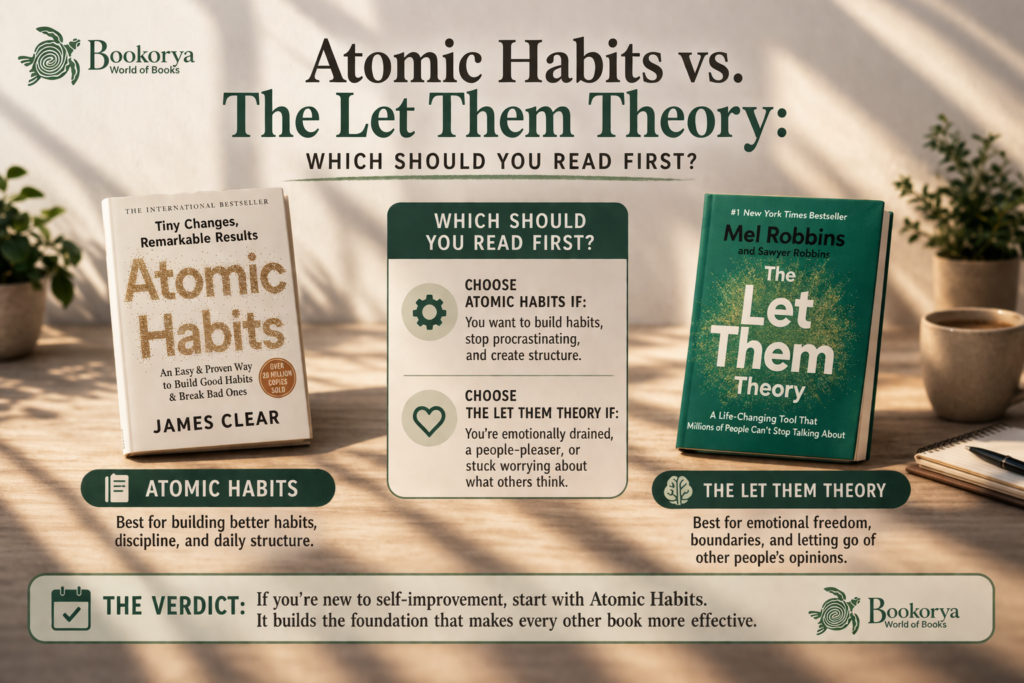
These two books come up most often in the “where do I start?” conversation—so let’s settle it clearly.
Beginner-friendliness: Both are accessible, but Atomic Habits wins here. It has a cleaner framework and very direct, practical advice. The Let Them Theory is conversational and warm, but assumes you’re already thinking about emotional patterns.
Emotional vs. practical: The Let Them Theory is fundamentally emotional—it’s about your relationship with other people and your own self-worth. Atomic Habits is fundamentally behavioral—it’s about systems and routines. Both are valuable, but they work on different parts of you.
Speed of results: Atomic Habits wins. You can implement something from Chapter 1 today and feel a difference this week. The Let Them Theory creates shifts that are slower but often deeper—you’ll stop exhausting yourself with others’ opinions over time, not overnight.
The verdict: Start with Atomic Habits if your biggest issue is doing—building discipline, creating structure, stopping procrastination.
Start with The Let Them Theory if your biggest issue is being—feeling free from other people’s expectations, releasing control, reconnecting with yourself.
Both books are worth reading. But if you’re completely new to self-improvement, Atomic Habits gives you a foundation that makes every other book you read afterward more effective.
Quick Decision Guide
Still not sure? Here’s the simplest breakdown possible:
- Start with Atomic Habits if you want to build better habits, stop procrastinating, or create structure in your daily life.
- Choose The Let Them Theory if you’re emotionally exhausted, a people-pleaser, or trapped in other people’s opinions.
- Pick The Psychology of Money if money causes you stress, shame, or confusion—and you want to change how you think about it.
- Read Think Again if you overthink, doubt your decisions, or feel stuck in your own head.
- Reach for Four Thousand Weeks if you’re burned out, overwhelmed, or questioning what you’re really doing with your life.
You don’t need all five. You need the one that meets you where you are right now.
Don’t overthink this. Pick one book from the list above and begin today. The right time is always now.
Frequently Asked Questions
Which self-improvement book should I read first — and where do I even begin?
For most people, Atomic Habits is the best starting point among all the best books for productivity and success. It builds the foundation—small, consistent actions—that makes every other area of self-improvement easier. Once you understand how habits work, you can apply that framework to your money, relationships, mindset, and time. Start there, then branch out based on what you need next.
Are self-help books actually worth it?
They can be—if you treat them as tools, not escapes. The mistake most people make is reading self-help books instead of taking action. The books in this guide are written by people who’ve done serious research and thinking on real human challenges. But the book doesn’t change your life. What you do after reading it does. One book, deeply read and genuinely applied, is worth more than a shelf of books left half-finished.
Can one book really change my life?
Honestly? Yes. Not because it contains magic—but because the right idea, at the right moment in your life, can shift the lens through which you see everything. It doesn’t happen with every book, and it doesn’t happen automatically. But when you find the book that speaks directly to your current struggle, it can feel like someone finally turned the lights on. That kind of clarity can absolutely change the direction of your life.
The Decision Is Already in Front of You
Here’s something worth sitting with: most people who feel stuck aren’t waiting for more information. They’re waiting for permission—permission to start, to change, to try something different.
That permission doesn’t come from finishing this article. It comes from making a decision.
You’ve been circling this for long enough. You’ve felt the gap between where you are and where you want to be. You’ve wondered if things could be different.
They can. But only if you do something differently than you did yesterday.
Pick one book. Just one. The one that made you lean forward a little when you read about it. The one that described your struggle before you even had the words for it.
Buy it. Read it. Don’t just read it—sit with it. Apply the smallest thing it asks of you.
You don’t need a complete transformation. You need a first step. And right now, that step is simpler than you think.
The right book is waiting. All you have to decide is: are you ready?